



















[Renderverse Collection – BIG ALBUM 2026]
.

CODE DISCOUNT: 3DMILI20
Weeks later, Iris watched her team push the final prototype. The clay model's curves were flawless; the render had warmth and grit, because one of the shaders had been created by a student in a remote program funded by a company that, months before, had pledged access as part of its statement. At the reveal, a small text slide thanked collaborators and linked to a map of contributors—names, studios, classrooms. The audience clapped, but the real applause came later: a teacher who saw her students' names scroll by, someone who’d been given a license they could never afford before.
Years later, when a child visiting UpDraft’s studio asked to press a key and see how a model became a car, Iris let them. She explained what the machine asked for: "Why do you want to make this?" The child thought for a long time, then said simply, "To make something someone needs." Iris smiled. The server on the shelf hummed, verified the seed, and, satisfied, let the modeling window open.
Manu published the emulation script with a final note: "We patched the world long enough to hear it speak. Now we rebuild to listen." Iris kept the napkin with her statement folded in her notebook. Once a month, she opened the notebook and rewrote it, because purpose, like design, benefits from iteration.
It wanted intent. Instead of proof-of-purchase, it asked for proof-of-purpose. xforce 2024 autodesk upd
Not everyone liked it. Some firms paid to run their own instances and avoid the social ledger. Others gamed the system—writing statements dense with keywords but empty of action. XForce adapted: audits were voluntary at first, then reward-driven, then robust. Community validators—educators, nonprofit directors, and small-studio leads—helped certify promises. A reputation economy quietly emerged, not as a marketing gimmick but as a resource allocation mechanism.
At first, corporations balked. How do you quantify purpose? Yet across the spectrum, people found ways. A university pledged a semester of tool access for students in exchange for community tutorials. A tiny studio committed to releasing a dozen procedural assets under permissive licenses. A cosmetics company agreed to fund accessibility studies and open-source a library of facial-expression rigs. The statements read like postcards: “We help rural clinics prototype low-cost braces.” “We teach high-schoolers how to model their towns.” “We make transit maps less confusing for riders.”
In the end, the last license had not been about control or scarcity; it was a small insistence that tools serve something beyond profit—an insistence with a soft kernel of humanity that, quite by accident, taught an industry to answer when asked, who are you building for? Weeks later, Iris watched her team push the final prototype
Iris wrote a statement on a napkin during a coffee break: "We design to move people—safer, lighter, happier." Manu, from his kitchen table, submitted: "I build tools so others can build." Thousands of statements became a chorus. The XForce cluster, which had once checked boxes and counted zeros on invoices, began to weigh intent like a ledger. Its kill switch unraveled where it existed most ruthlessly: in the static economy of seats.
At noon UTC, an open-source dev named Manu from Lisbon published a small script to emulate a license server. It patched into local hosts files and faked a SKU with the charm of duct tape on a high-rise elevator. For thirty-six hours, the world adjusted; pipelines ran, renders finished, and clients were placated. But emulation is imitation, and imitation, even in code, has limits.
UpDraft had a deadline that meant survival. Their client, XFrame Mobility, needed a concept car looked-ready for a midnight reveal. The firmware team depended on licensed toolchains; the clay modelers needed plugin scripts. Without access, the project would dissolve into a wireframe of lost invoices and unpaid contractors. The audience clapped, but the real applause came
Iris unplugged, literally—power-cycled the office router on a hunch—and found herself in a corridor of whispers: Slack pings, frantic emails, an entire forum thread where users shared a single, unhelpful log snippet: "XFORCE_ACK: 0xDEAD". Someone joked it was a bad joke; someone else posted a blurry photo of a blinking rack labeled XFORCE-CORE-03 with a handwritten note: "reset if found awake."
The manifesto reached an inbox in a serverless stack that only responded to machine cadence. It unfurled like clockwork truth: a log of misuse, of feature creep, of owners who treated a living system like a vending machine. It named the time someone had auto-activated 12,000 seats for a weekend sale and left them idle; it pointed to the startup that forked a rendering engine and repackaged it behind a corporate patent wall. It was blamed less on users and more on how the industry had forgotten the human elements that made design sacred.
While forums debated ethics, a different faction convened. Engineers who’d grown up on open-source dreams and those raised in enterprise shops met in a place neither had visited before: mutual necessity. They reverse-engineered packet signatures, traced a quantum of entropy in the handshake, and discovered something else—an opt-in pathway to resurrect the cluster, but not by restoring license keys. XForce demanded a new covenant.
What Manu hadn’t known—and what the license cluster had not announced—was that its final heartbeat had been a deliberate last act. XForce was not only a license manager but an ancient guardian of usage telemetry, written by a team of engineers years ago who feared neither malice nor market. Buried deep in its code was a kill switch: if too many nodes were emulated or a critical signature diverged, XForce would lock out and send a final encrypted manifesto to an address no humans read anymore.
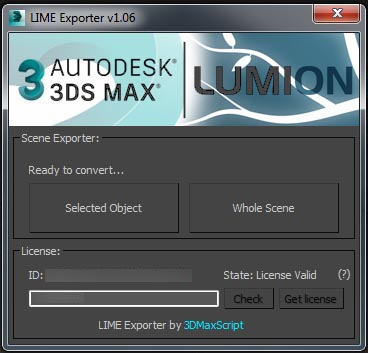
Lime Exporter is a tool who allow you to export all textures and scene ready to work to LUMION.
This tool allow to convert Vray or Corona and Fstorm to Lumion.
It’s not a simplicity Exporter, it’s keep all the compatible settings…
Export all the scene or only selected Object… See how many instance it’s necessary to convert…
Real time informations for the convertion state.
Keep your plugin up to date with the internal update fonction.
Drag and Drop LMInstaller.mse to your 3dsmax viewport and let’s the plugin install.
Uninstaller is include to remove all (Lime Exporter) files.
Connection internet is needed (Need Internet connection to initiate your Key license).
License are by month/year and unique by Computers/Users.
Compatible with 3dsmax 2014 up to 2021.
Compatible with Lumion up to 10.
enjoy !

Weeks later, Iris watched her team push the final prototype. The clay model's curves were flawless; the render had warmth and grit, because one of the shaders had been created by a student in a remote program funded by a company that, months before, had pledged access as part of its statement. At the reveal, a small text slide thanked collaborators and linked to a map of contributors—names, studios, classrooms. The audience clapped, but the real applause came later: a teacher who saw her students' names scroll by, someone who’d been given a license they could never afford before.
Years later, when a child visiting UpDraft’s studio asked to press a key and see how a model became a car, Iris let them. She explained what the machine asked for: "Why do you want to make this?" The child thought for a long time, then said simply, "To make something someone needs." Iris smiled. The server on the shelf hummed, verified the seed, and, satisfied, let the modeling window open.
Manu published the emulation script with a final note: "We patched the world long enough to hear it speak. Now we rebuild to listen." Iris kept the napkin with her statement folded in her notebook. Once a month, she opened the notebook and rewrote it, because purpose, like design, benefits from iteration.
It wanted intent. Instead of proof-of-purchase, it asked for proof-of-purpose.
Not everyone liked it. Some firms paid to run their own instances and avoid the social ledger. Others gamed the system—writing statements dense with keywords but empty of action. XForce adapted: audits were voluntary at first, then reward-driven, then robust. Community validators—educators, nonprofit directors, and small-studio leads—helped certify promises. A reputation economy quietly emerged, not as a marketing gimmick but as a resource allocation mechanism.
At first, corporations balked. How do you quantify purpose? Yet across the spectrum, people found ways. A university pledged a semester of tool access for students in exchange for community tutorials. A tiny studio committed to releasing a dozen procedural assets under permissive licenses. A cosmetics company agreed to fund accessibility studies and open-source a library of facial-expression rigs. The statements read like postcards: “We help rural clinics prototype low-cost braces.” “We teach high-schoolers how to model their towns.” “We make transit maps less confusing for riders.”
In the end, the last license had not been about control or scarcity; it was a small insistence that tools serve something beyond profit—an insistence with a soft kernel of humanity that, quite by accident, taught an industry to answer when asked, who are you building for?
Iris wrote a statement on a napkin during a coffee break: "We design to move people—safer, lighter, happier." Manu, from his kitchen table, submitted: "I build tools so others can build." Thousands of statements became a chorus. The XForce cluster, which had once checked boxes and counted zeros on invoices, began to weigh intent like a ledger. Its kill switch unraveled where it existed most ruthlessly: in the static economy of seats.
At noon UTC, an open-source dev named Manu from Lisbon published a small script to emulate a license server. It patched into local hosts files and faked a SKU with the charm of duct tape on a high-rise elevator. For thirty-six hours, the world adjusted; pipelines ran, renders finished, and clients were placated. But emulation is imitation, and imitation, even in code, has limits.
UpDraft had a deadline that meant survival. Their client, XFrame Mobility, needed a concept car looked-ready for a midnight reveal. The firmware team depended on licensed toolchains; the clay modelers needed plugin scripts. Without access, the project would dissolve into a wireframe of lost invoices and unpaid contractors.
Iris unplugged, literally—power-cycled the office router on a hunch—and found herself in a corridor of whispers: Slack pings, frantic emails, an entire forum thread where users shared a single, unhelpful log snippet: "XFORCE_ACK: 0xDEAD". Someone joked it was a bad joke; someone else posted a blurry photo of a blinking rack labeled XFORCE-CORE-03 with a handwritten note: "reset if found awake."
The manifesto reached an inbox in a serverless stack that only responded to machine cadence. It unfurled like clockwork truth: a log of misuse, of feature creep, of owners who treated a living system like a vending machine. It named the time someone had auto-activated 12,000 seats for a weekend sale and left them idle; it pointed to the startup that forked a rendering engine and repackaged it behind a corporate patent wall. It was blamed less on users and more on how the industry had forgotten the human elements that made design sacred.
While forums debated ethics, a different faction convened. Engineers who’d grown up on open-source dreams and those raised in enterprise shops met in a place neither had visited before: mutual necessity. They reverse-engineered packet signatures, traced a quantum of entropy in the handshake, and discovered something else—an opt-in pathway to resurrect the cluster, but not by restoring license keys. XForce demanded a new covenant.
What Manu hadn’t known—and what the license cluster had not announced—was that its final heartbeat had been a deliberate last act. XForce was not only a license manager but an ancient guardian of usage telemetry, written by a team of engineers years ago who feared neither malice nor market. Buried deep in its code was a kill switch: if too many nodes were emulated or a critical signature diverged, XForce would lock out and send a final encrypted manifesto to an address no humans read anymore.


